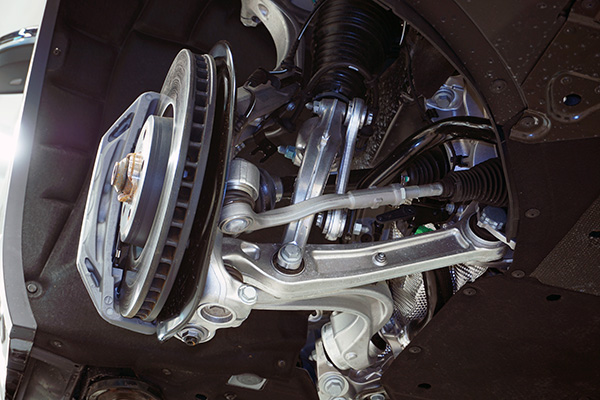
A newer car can feel comfortable on an uneven street, then settle more firmly when you choose another driving mode. If it has adaptive suspension, that change may come from dampers whose operation is adjusted electronically as you drive.
The system still relies on the same basic job of controlling suspension movement. Electronics can change the response, but they don't remove the need for sound tires, springs, joints, and mounts. Understanding both sides helps explain what changes when a problem develops.
Adaptive Dampers Change How Suspension Movement Is Controlled
After a wheel hits a bump, a spring stores and releases energy. The shock or strut damper controls that movement so the body does not keep bouncing. In an adaptive system, the amount of damping can change according to commands from the vehicle's controls.
The method depends on the design. Some dampers adjust internal fluid flow electronically, while others use a different controllable arrangement. The result is a suspension that can respond differently under different conditions. That does not mean it can eliminate every bump or make worn mechanical parts behave like new ones.
Adaptive Suspension Uses Sensors To Read Driving Conditions
The controller may receive information about body movement, steering, wheel movement, speed, and other operating conditions. It uses those inputs to decide how the dampers should respond. A sudden steering input or a rough patch can call for a different response from steady driving on a smooth road.
The sensor list and control strategy vary by vehicle. A damaged sensor connection can affect the system even when the damper itself has no visible leak. That is why checking an adaptive suspension complaint involves both the mechanical components and the information the controller is receiving.
Driving Modes Can Change Adaptive Suspension Feel
A comfort setting often favors a more relaxed response, while a sport setting may make body movement feel more controlled. The exact difference depends on the vehicle. Some modes also change steering, throttle, or transmission behavior, so the driver's overall impression doesn't come from the dampers alone.
Pay attention to how your own vehicle normally responds in each mode. If a familiar setting suddenly feels harsh, floaty, or uneven from one corner to another, report that change. Comparing it with another model's ride is less helpful because the suspension and tires may be designed quite differently.
Adaptive Suspension Still Needs Healthy Mechanical Parts
Electronic control cannot remove play from a worn ball joint or restore support to a separated bushing. Tire pressure and tread condition also influence the ride. A car can have functioning adaptive dampers and still feel unsettled if another part of the suspension has deteriorated.
We inspect springs, mounts, links, joints, and tires alongside the dampers. A clunk may come from a loose connection rather than the electronically controlled component. Starting with the whole assembly helps avoid replacing an expensive damper while leaving the actual source of the noise or instability in place.
An Adaptive Suspension Fault Can Change The Response
A warning may appear if the system detects an electrical or operating fault. Depending on the vehicle, it may use a limited or default response instead of the full adaptive function. The driver could notice a firmer ride, less difference between modes, or another change in handling.
Compare those symptoms with fault information and live system data, where available. They do not prove that all the dampers need replacement. Wiring, power supply, sensors, and the individual components need checks that follow the vehicle's procedure. Mention whether the warning appeared after a pothole impact, battery work, or another repair.
Adaptive Damper Replacement Requires The Correct Parts
Two dampers can look similar while having different control characteristics or part requirements. The replacement should match the vehicle and suspension option. Installing a conventional unit or an incompatible electronic damper can change operation and may create warnings unless the modification has been properly evaluated.
Some repairs require setup, initialization, or other specified checks afterward. Wheel alignment may also be necessary depending on what was removed. Ask what the estimate includes beyond the component itself. The finished repair should restore the intended operation, not simply remove a leaking part and leave the electronic system unverified.
Adaptive Suspension Concerns Are Easier To Trace With Details
Describe whether the change appears over sharp bumps, during turns, or while braking. Note the driving mode and whether the problem happens when the car is cold or after a longer trip. A photo of a warning message can help if it disappears before the appointment. An occasional warning is still useful to report even if the ride returns to normal.
Regular maintenance still provides a chance to check for leaks, damaged wiring, uneven tire wear, and worn connections. If the vehicle suddenly becomes difficult to control, stop driving and arrange an inspection. A comfortable ride on one stretch of road does not establish that an intermittent suspension problem is safe to ignore.
Get Adaptive Suspension Service In Montello, WI, With Northside Automotive
If your vehicle's ride changes unexpectedly or an adaptive suspension warning appears, Northside Automotive in Montello, WI, can inspect the mechanical parts and electronic controls to find the source.
Contact us to schedule an adaptive suspension inspection.